

The Process Led Organization: How to Build Systems That Enable Innovation
By Daniel Toebe on
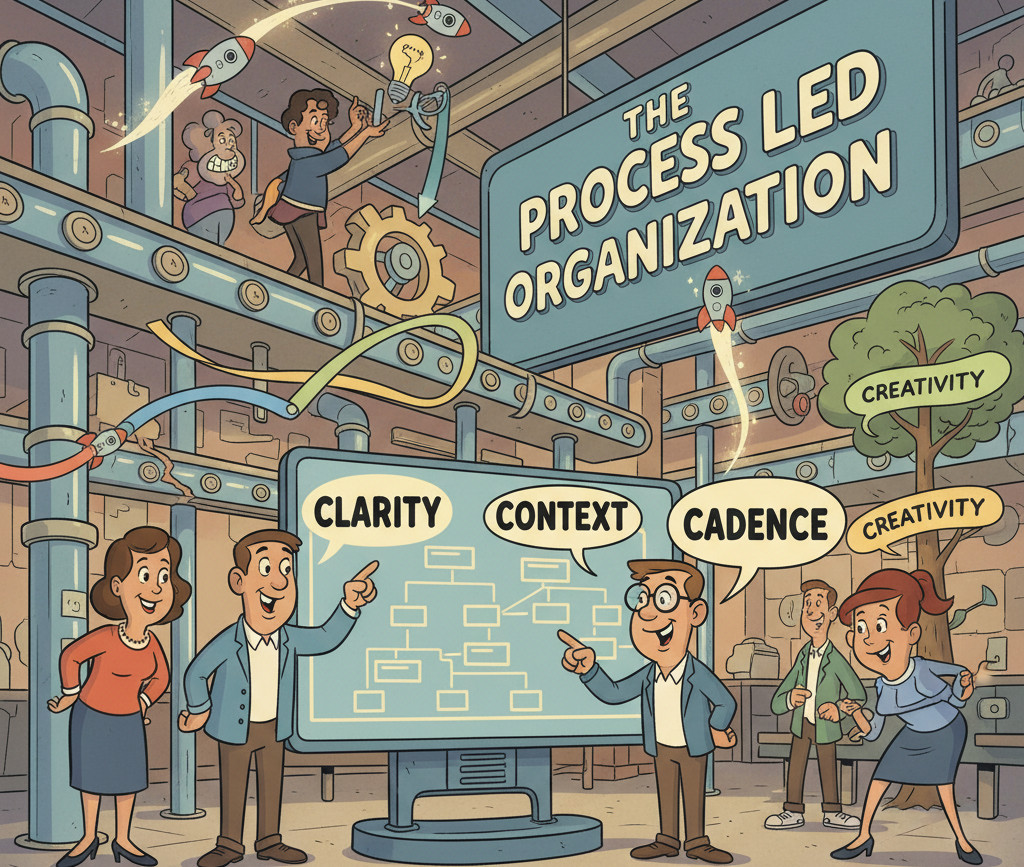
Most leaders treat “process” like a dirty word.
It conjures images of bureaucracy, endless meetings, and creativity being strangled by red tape.
But in reality, it’s not process that kills innovation.
It’s the lack of process that kills execution, and innovation dies in the chaos that follows.
The organizations that consistently innovate aren’t the ones moving fastest.
They’re the ones moving deliberately, guided by systems that create clarity, context, and cadence.
Process isn’t a set of rules; it’s the infrastructure for innovation.
1. The Myth of “Move Fast and Break Things”
“Move fast and break things” works… until it doesn’t.
That mantra drives early momentum, but at scale it becomes a liability.
When teams grow beyond a handful of people, tribal knowledge and improvisation start to break down.
What once felt like speed becomes friction: duplicated work, misaligned decisions, and inconsistent execution.
Mature organizations swing to the other extreme, over-processing everything.
They build layers of control and approval, suffocating initiative in the name of governance.
Both approaches fail for the same reason: they treat process as control, not clarity.
The turning point comes when leadership realizes that heroics don’t scale, frameworks do.
A process led organization doesn’t slow you down; it removes the noise that’s been slowing you all along.
2. The Three Pillars of a Process Led Organization
Process led organizations operate on three foundational pillars: Clarity, Context, and Cadence.
Clarity
Clarity is the antidote to chaos.
It defines roles, expectations, and outcomes so teams can execute without guessing.
- Everyone knows what “done” means.
- Every initiative has an owner.
- Every dependency is visible.
Clarity doesn’t require more meetings or thicker manuals; it requires shared language.
A two-sentence definition understood by everyone beats a fifty-page playbook no one reads.
Context
Context connects purpose to process.
Without it, teams follow rules without understanding why.
Context is what allows teams to make aligned decisions in real time.
It flows downward from leadership and upward from execution through continuous feedback loops.
When leaders share why a process exists, not just what it is, teams start to engage rather than comply.
Process without context breeds compliance; process with context breeds commitment.
Cadence
Cadence is the rhythm that keeps the system alive.
It’s how you turn plans into predictable momentum.
- Weekly check-ins maintain alignment.
- Monthly reviews close feedback loops.
- Quarterly retros create renewal and adaptation.
Cadence transforms static processes into living systems.
It’s the heartbeat of a process led organization, consistent enough to build trust, flexible enough to evolve.
3. The Process Maturity Ladder
Organizations evolve through distinct stages of process maturity.
Understanding where you are helps you identify what to fix, and what to stop doing.
| Stage | Description | Characteristics | Risks | Next Step |
|---|---|---|---|---|
| 1. Ad Hoc | Work happens by intuition and heroics. | Reactive culture, dependency on key people. | Burnout, rework, fragility. | Define repeatable workflows. |
| 2. Documented | Processes exist but aren’t practiced. | “Shelfware” documentation, inconsistent results. | Low accountability, process fatigue. | Reinforce through shared ownership. |
| 3. Embedded | Teams live the process. | Predictable outcomes, shared vocabulary. | Risk of rigidity. | Introduce feedback loops and metrics. |
| 4. Adaptive | Continuous improvement culture. | Self-correcting systems, learning mindset. | Requires strong leadership commitment. | Institutionalize experimentation. |
Your goal isn’t to reach “perfect process”;
it’s to evolve toward adaptive process, where structure supports learning, not stifles it.
4. Building a Process Led Culture
Most process initiatives fail because they’re imposed, not internalized.
A process led culture starts with mindset, not mechanics.
- Frame process as freedom. Clear boundaries allow teams to move faster with confidence.
- Teach the why. Every workflow exists to remove friction or reduce risk; make that visible.
- Reward refinement. When teams improve a process, celebrate it. Treat iteration as innovation.
- Lead by example. If leadership skips retros or bypasses the system, the message is clear: the process doesn’t matter.
Process only scales when it’s owned, not enforced.
5. The Process-Driven Innovation Loop
Innovation thrives when execution friction is low.
The Process-Driven Innovation Loop connects structure to creativity:
Insight -> Process -> Measurement -> Adaptation -> Innovation
- Insight: Capture what’s working, or what’s broken.
- Process: Design a repeatable way to act on it.
- Measurement: Track the outcome and its impact.
- Adaptation: Adjust based on data and feedback.
- Innovation: Use the freed bandwidth and confidence to experiment again.
When this loop runs continuously, process and innovation reinforce each other.
Your team stops choosing between order and creativity, they start seeing process as the way to sustain creativity.
6. Implementation Framework: Turning Theory Into Action
Here’s how to start building a process led organization from wherever you are:
- Map Reality.
Document what’s actually happening, not what’s supposed to happen. Identify bottlenecks, unclear ownership, and unspoken dependencies.
This is the most important step, and you have to be brutally honest with yourself.
-
Define the System.
Choose one area, like onboarding, roadmap planning, or vendor management, and design a simple, visible workflow. Clarity first, automation later. -
Integrate Feedback.
Establish how you’ll collect input from the people living the process daily. Feedback isn’t optional; it’s the fuel for improvement. -
Reinforce with Rituals.
Cadence is what turns process from a document into behavior. Use recurring check-ins, retros, and reviews to reinforce the rhythm. -
Scale and Adapt.
Once it works for one team, share the framework. Let each team adapt it to their context instead of enforcing a one-size-fits-all template.
The goal isn’t to create uniformity; it’s to create alignment through structure.
7. Process as the Path to Velocity
Innovation doesn’t come from chaos.
It comes from organizations that have the confidence and clarity to take calculated risks.
A process led organization moves faster because it’s disciplined.
Teams waste less time redefining “how” and spend more time improving the “what.”
When your systems are clear, your strategy is free to evolve.
When your cadence is predictable, your creativity compounds.
Process doesn’t slow innovation; it scales it.
Because when clarity, context, and cadence converge,
velocity becomes the by-product of design.